ditty ID: 3455

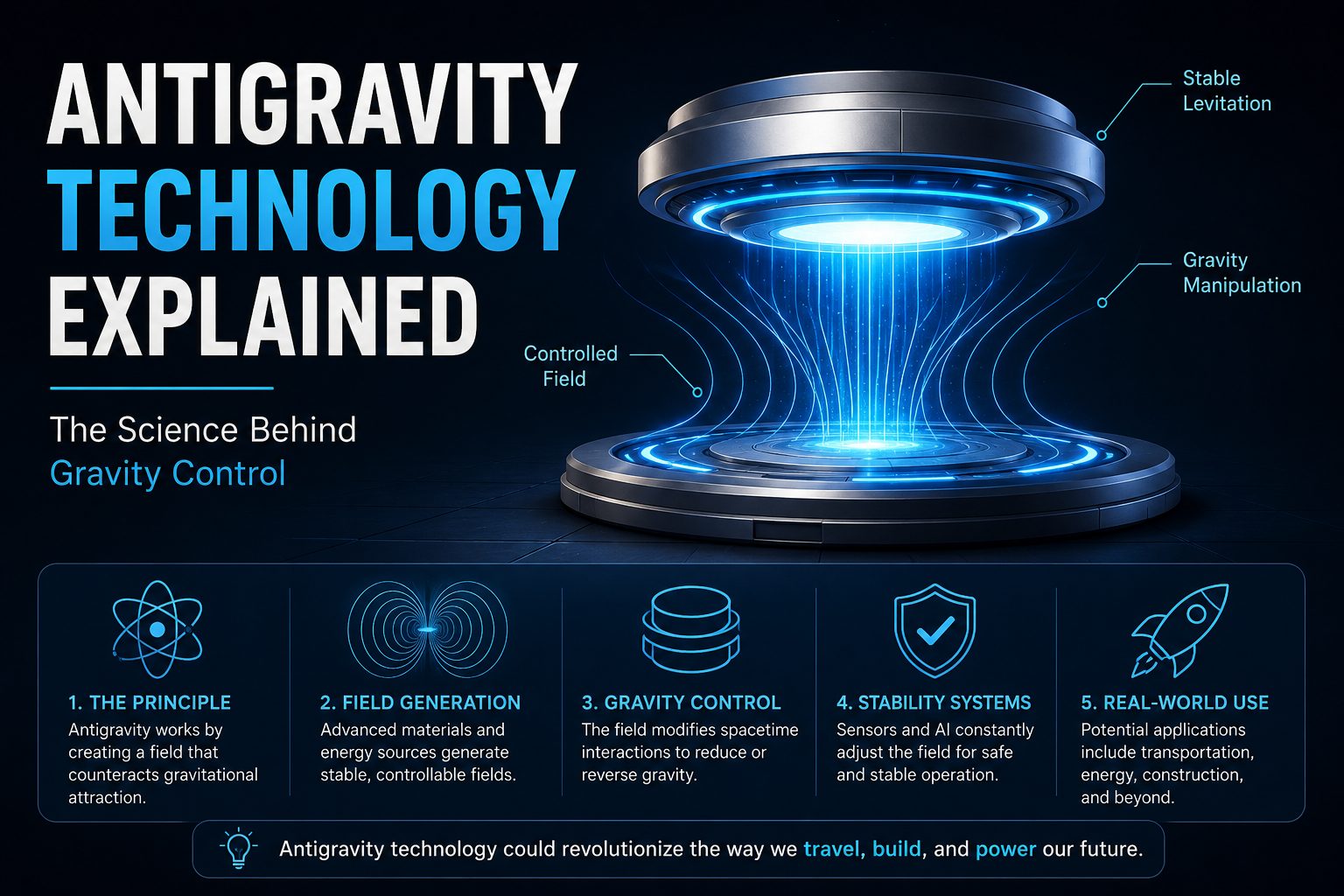

Since the dawn of human civilization, our greatest limitation has been the invisible, relentless force anchoring us to the ground: gravity. From the earliest rudimentary flying machines to the colossal Saturn V rockets that took humanity to the moon, every milestone in transportation has been a violent, energy-intensive battle against Earth’s gravitational well.
But what if we stopped fighting gravity and learned to manipulate it instead?
Welcome to the definitive, deep-dive exploration of gravitational physics. In this comprehensive, multi-chapter guide, we will unpack Antigravity Technology Explained from absolute zero to advanced quantum mechanics. We will strip away the science fiction tropes to examine the real physics frameworks, the current state of levitation technologies, and provide a step-by-step roadmap of how humanity will eventually harness, build, and use true antigravity engines.
(Note for you: Upar wali image par click karke isko Replace kar dena apni pasand ki image se, iska Alt Text maine pehle se keyword par set kar diya hai!)
Chapter 1: The Fundamental Mechanics of Antigravity Technology Explained
To comprehend how to reverse or nullify gravity, we must first understand what it actually is. For centuries, our understanding of this force was strictly classical, defined by Sir Isaac Newton. Newton proposed that gravity was an invisible “pulling” force acting instantaneously across distances, governed by the mass of the objects involved.
His universal law of gravitation was elegantly simple: it stated that every particle in the universe attracts every other particle with a force that is directly tied to their mass and the distance between their centers. While this classical framework was accurate enough to send the Apollo missions to the moon, it failed to explain why gravity exists, which is the foundational question behind Antigravity Technology Explained.
The Einsteinian Revolution: Spacetime Curvature
In 1915, Albert Einstein completely shattered the Newtonian model with his Theory of General Relativity. Einstein revealed that gravity is not a “pulling force” at all. Instead, it is the geometric warping of the four-dimensional fabric of the universe, known as spacetime.
Imagine a tightly stretched trampoline. If you place a heavy bowling ball (representing a planet like Earth) in the center, the fabric sags and curves downwards. If you roll a marble (representing the Moon or an apple) across the edge, it spirals inward toward the bowling ball. The marble isn’t being “pulled” by a magnetic force; it is simply following the curved path of the fabric.
This relationship between mass, energy, and spacetime curvature was mathematically defined by his famous Field Equations. In his complex framework, one side of the equation describes the geometry and curvature of spacetime, while the other side represents the distribution of mass and energy. Stated simply: “Spacetime tells matter how to move; matter tells spacetime how to curve.” Understanding this curvature is the first step in getting Antigravity Technology Explained correctly.
Chapter 2: Defining True Antigravity
With Einstein’s framework established, we can define what true antigravity actually entails.
Many people confuse antigravity with levitation. An airplane uses the aerodynamic lift of its wings to push against air pressure. A helicopter uses rotors. A Maglev train uses electromagnetic repulsion. All of these technologies are simply using a stronger force to temporarily fight gravity.
To get Antigravity Technology Explained in its purest form, it requires the direct manipulation of the spacetime metric itself. It means building a machine or generating a field that tells spacetime to curve upward instead of downward, effectively creating a localized hill in the spacetime fabric that pushes mass away.
The Physics of Exotic Matter and Negative Mass
According to current theoretical models, creating an antigravity field requires a substance that does not naturally exist in our observable universe: Exotic Matter.
In traditional physics, if you push an object with positive mass, it accelerates away from you. If negative mass existed, pushing it would cause it to accelerate toward you. More importantly, while positive mass curves spacetime downward (creating a gravitational well), negative mass would curve spacetime upward. If a spacecraft could be encased in a shell of negative mass, it would become completely decoupled from Earth’s gravitational pull.
Chapter 3: Stepping Stones in Antigravity Technology Explained
While we do not yet have access to negative mass, modern laboratories are executing groundbreaking experiments that simulate antigravity environments. These are the stepping stones toward true spacetime manipulation that make Antigravity Technology Explained a reality in modern labs.
1. Quantum Levitation and the Meissner Effect
At the bleeding edge of modern materials science is Quantum Levitation. When certain ceramic materials (superconductors) are cooled below a critical temperature using liquid nitrogen, their electrical resistance drops to absolute zero.
When a superconductor reaches this quantum state, it expels all internal magnetic fields—a phenomenon called the Meissner Effect. If you place this supercooled puck over a magnetic track, the magnetic field lines physically cannot penetrate the superconductor. Instead, they wrap around it, “locking” the object into mid-air. It does not just hover; it is structurally pinned in 3D space.
2. Antimatter Research at CERN
Antimatter is the mirror image of standard matter. At the CERN particle accelerator, scientists have successfully trapped and observed Antihydrogen. The critical question physicists asked was: Does antimatter fall up?
Recent experiments confirmed that antimatter does, in fact, fall “down” toward Earth, reacting to spacetime curvature the same way regular matter does. However, quantum anomalies are still being heavily researched, adding new layers to how Antigravity Technology Explained will evolve in the coming decade.
Chapter 4: Theoretical Frameworks for Real Antigravity Engines
How do we move from theoretical physics to mechanical engineering? Several advanced models propose how a true antigravity engine might function. A core component of Antigravity Technology Explained is understanding these theoretical drives.
A. The Alcubierre Warp Metric
Proposed by theoretical physicist Miguel Alcubierre in 1994, this model doesn’t just theorize antigravity; it theorizes faster-than-light travel. The Alcubierre metric solves Einstein’s equations by proposing a spacecraft encased in an “energy bubble.”
The advanced physics dictates that the ship uses extreme energy to contract spacetime directly in front of the vessel while simultaneously expanding spacetime directly behind it. Inside this protective energy bubble, the ship is perfectly stationary, experiencing zero G-forces. It is the spacetime fabric itself that moves, carrying the ship along with it like a surfer riding a wave.
B. Electrogravitics (The Biefeld-Brown Effect)
In the early 20th century, researchers discovered that when an asymmetric capacitor is subjected to high-voltage direct current, it experiences a net physical thrust toward the smaller electrode. While mainstream science largely attributes this to “ionic wind”, classified military programs have heavily researched scaling this up for aerospace propulsion in vacuum environments.
Chapter 5: How We Will Use Antigravity Technology Explained
If humanity successfully engineers a scalable gravity-nullification device, the transition will happen in distinct, world-altering phases. Here is the step-by-step roadmap of how Antigravity Technology Explained translates into real-world deployments.
Phase 1: Revolutionizing Global Supply Chains and Logistics
The first commercial application of antigravity will not be flying cars; it will be raw industrial logistics. Much like how modern digital systems focus on scaling operational pipelines using automation blueprints, the physical world will use gravity dampeners to scale heavy transport. Heavy shipping containers and cargo planes will be retrofitted with base-layer gravitational shielding plates.
Phase 2: Urban Infrastructure and Personal Mobility
Once the technology is miniaturized and made safe for dense populations, our cities will transform. Without rolling friction or the need to counteract immense weight, vehicles will become hyper-efficient. Roads, bridges, and highways will no longer require millions of tons of concrete and steel reinforcement.
Phase 3: Architectural Levitation and Megastructures
When lifting heavy objects costs nothing, human architecture will break free from structural limitations. We will build structures that are physically impossible under standard physics. Mile-high skyscrapers will no longer collapse under their own weight.
Phase 4: Interstellar Colonization and Deep Space Expansion
The ultimate destiny of Antigravity Technology Explained is the stars. The biggest barrier to space travel today is the reality that 90% of a rocket’s mass is just the fuel required to escape Earth’s gravity well. Spacecraft will utilize antigravity drives to leave the atmosphere without chemical combustion. Massive, heavily armored colony ships will smoothly lift off from the ground with zero noise and zero exhaust.
Chapter 6: The Great Engineering Bottleneck
If the physics models exist and the theories are sound, why don’t we have antigravity engines today? The final piece of Antigravity Technology Explained comes down to one absolute barrier: Energy Density.
Manipulating spacetime requires an incomprehensible amount of energy. Generating and storing that much energy remains centuries beyond our current nuclear capabilities. Until we unlock a unified theory of quantum gravity—bridging the gap between the macro-world of Einstein’s relativity and the micro-world of quantum mechanics—true antigravity remains locked behind a wall of energy generation.
Chapter 7: The Final Conclusion
The pursuit of Antigravity Technology Explained is not just a scientific novelty; it is the ultimate imperative for the survival and expansion of the human race. Every ounce of fuel we burn, every bridge we build, and every rocket we launch is a struggle against the curvature of spacetime.
From the quantum levitation of superconductors in modern labs to the theoretical warp drives of tomorrow, the breadcrumbs of antigravity are actively being discovered. When the breakthrough finally occurs, it will not just be a new invention—it will be a fundamental rewrite of the laws of nature, elevating humanity from Earth-bound observers to masters of the cosmic fabric.