ditty ID: 3455

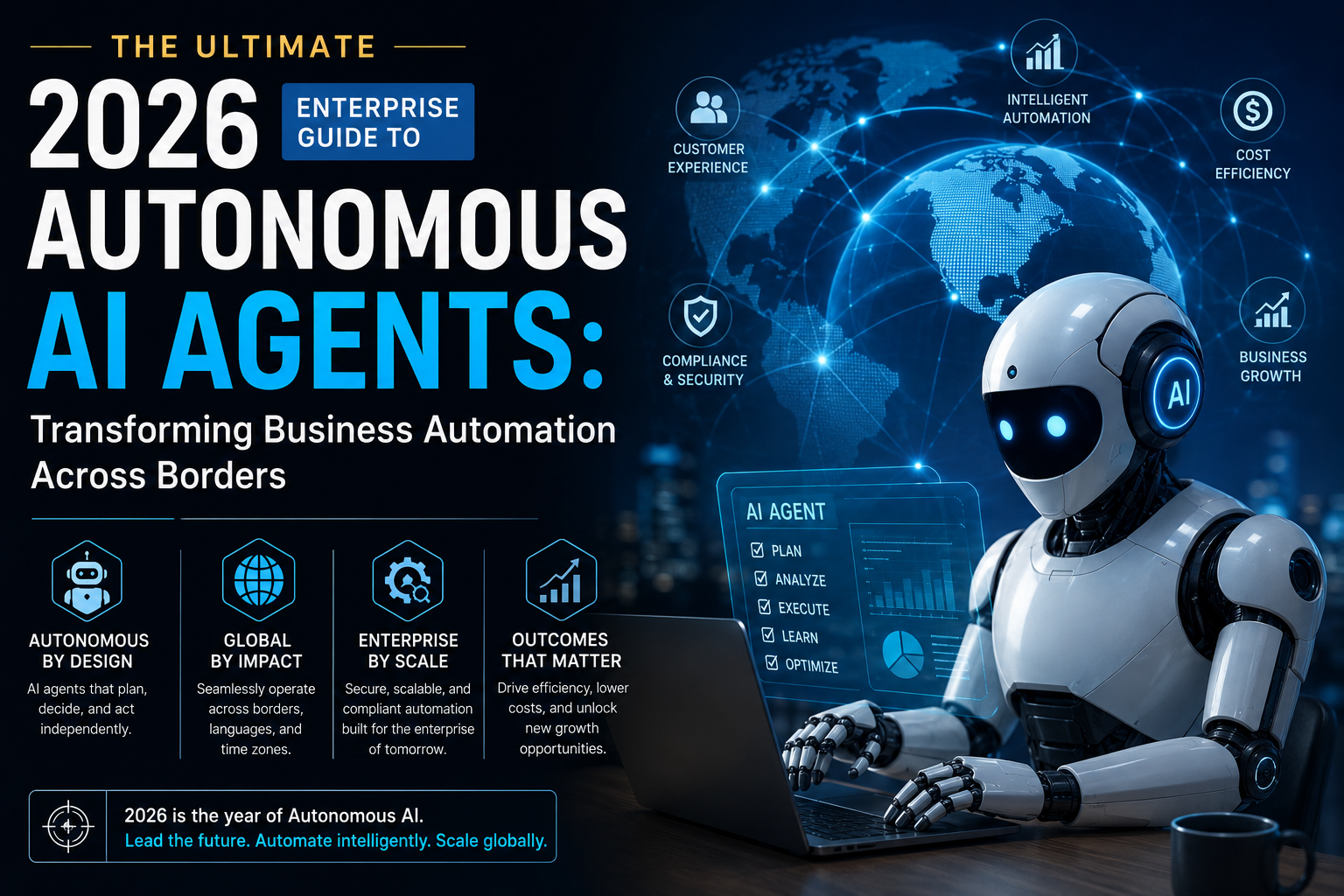

What are Autonomous AI Agents? Autonomous AI Agents are goal-driven, self-governing software systems powered by advanced foundation models that independently execute end-to-end operational workflows. Unlike conversational chatbots, they possess persistent vector memory, execute dynamic task deconstruction, utilize secure multi-API connections, and self-correct runtime anomalies to scale international business automation without human-in-the-loop dependencies.
1. The Technological Shift: The Evolution from Chatbots to Autonomous AI Agent Ecosystems
The architectural paradigm of enterprise software deployment has faced a monumental displacement as we advance through 2026. For years, organizational digital transformation focused heavily on linear system configurations—deterministic software structures where every input required a predefined output pathway. When generative large language models (LLMs) burst onto the corporate stage, they offered localized text generation, internal conversational interfaces, and intelligent document summarization capabilities. However, they remained fundamentally restricted: they were passive tools constrained by human prompt parameters.
Enter the epoch of autonomous systems. Today’s enterprise landscape is defined not by how efficiently a human can query an artificial intelligence engine, but by how fluidly autonomous AI agents can act as self-sustaining operational nodes across fragmented business departments. These advanced autonomous units transcend the boundaries of basic text generation; they process real-time contextual variables, orchestrate cross-border software execution layers, and monitor execution parameters independently.
By utilizing self-directed execution cycles, enterprise frameworks have pivoted permanently from localized software tools toward independent digital workforces capable of executing multi-layered data strategies at a truly massive scale.
2. Structural Architecture: How Autonomous AI Agents Process Operations
To systematically deploy scalable digital infrastructure, enterprise technology leaders must understand the structural mechanics behind self-directed agent nodes. An industrial-grade autonomous agent does not merely pass a single query to an underlying LLM framework. Instead, it relies on a sophisticated cognitive architecture consisting of four essential layers: Long-Term Memory Storage, Hierarchical Action Planning, Real-time Execution Controls, and Dynamic Self-Correction loops.
The Deep Core Architectural Matrix
The functional difference between passive generation layers and true operational execution models is detailed in the structured evaluation below:
| Architectural Component | Conversational Chatbot Systems (Legacy Layer) | Autonomous AI Agent Frameworks (Modern Enterprise Era) |
| Operational Control | Linear prompt engineering cycles | Self-directed structural goal-decomposition loops |
| Memory Architecture | Temporary session context windows | Persistent Long-Term Vector Databases (Milvus, Pinecone) |
| Execution Capacity | Text responses and file summaries | Active secure webhooks and multi-platform API calls |
| Anomalous Correction | Requires immediate manual prompt fix | Automated algorithmic loop validation against SOPs |
| Data Scalability | Siloed, singular execution frames | Distributed multi-agent cluster synchronization |
Understanding Vector Memory Optimization
At the center of sustainable execution is long-term memory retrieval. Autonomous AI agents leverage high-performance vector databases to store semantic representations of business history. When a fresh cross-border marketing lead generation transaction or operational problem presents itself, the agent runs mathematical cosine similarity functions over indexed embeddings:
$$\text{Similarity}(A, B) = \frac{A \cdot B}{\|A\| \|B\|}$$
This programmatic framework allows autonomous AI agents to dynamically fetch hyper-contextual resolution data from past years within milliseconds. Consequently, instead of hallucinating inaccurate data arrays, the system builds an internal baseline rooted in certified corporate data repositories, maintaining pristine structural data integrity across international cloud parameters.
3. Worldwide Scale Blueprint: Integrating Multi-Agent Systems in Corporate Workflows
Deploying enterprise-grade business automation across diverse operations requires setting up structured, multi-agent frameworks where individual, highly specialized autonomous units coordinate to achieve massive milestones. Legacy pipelines relied on a single AI engine trying to solve every technical requirement, which often led to context bloat and systemic runtime failures. Modern enterprise engineering, however, builds parallel agent clusters where each individual component is isolated within a rigid operational loop.
Designing a Strategic Orchestration Framework
To implement a highly scalable, cross-border lead generation and corporate data ecosystem, technical leads must establish clear agent boundaries. For example, a multi-national sales operations system can be distributed across three distinct autonomous nodes:
- The Ingestion Node: Continuously monitors changing target firm graphics, parses real-time regulatory business changes, updates master data pools, and calculates programmatic validity checks.
- The Personalization Engine: Evaluates localized regional challenges, references past successful communication profiles, builds contextual outbound data sequences, and aligns copy metrics with international brand compliance.
- The Analytic Orchestrator: Regularly tracks system delivery metrics, validates user conversion rates, interacts with payment gateways, and manages data streams dynamically to eliminate delivery friction.
The programmatic orchestration of this self-directed task delegation can be configured via clean, enterprise-ready initialization structures:
import os
from enterprise_agent_framework import AgentCluster, TaskOrchestrator, VectorCache

def initialize_international_automation_pipeline():
    # Set up storage infrastructure for memory indexing
    memory_vault = VectorCache(provider="milvus", secure_layer=True)

    # Define specialized agent capabilities
    ingestion_unit = AgentCluster.create_node(
        role="Lead Generation Specialist",
        memory=memory_vault,
        allow_delegation=False,
        max_turnaround_time_seconds=120
    )

    analysis_unit = AgentCluster.create_node(
        role="International Data Analyst",
        memory=memory_vault,
        allow_delegation=True,
        target_currency="USD"
    )

    # Deploy orchestration to execute multi-layered corporate workflows
    cross_border_pipeline = TaskOrchestrator(
        nodes=[ingestion_unit, analysis_unit],
        verbose=True,
        security_clearance_level=5
    )

    return cross_border_pipeline.execute_workflow(objective="Scale outreach across international sectors")

if __name__ == "__main__":
    initialize_international_automation_pipeline()
4. Deep Dive: The Core Operational Mechanics of Autonomous AI Agents
To truly leverage the true potential of modern business automation, multi-national enterprises must move beyond linear automated scripts. True autonomous systems operate on a closed-loop perception-action cycle.
The Inner Workings: Memory, Planning, and Execution
An enterprise-ready autonomous AI agent relies heavily on three core cognitive frameworks:
- Long-Term Vector Memory: Unlike basic LLM interfaces that forget context after a chat session ends, autonomous AI agents utilize vector databases (like Pinecone, Milvus, or ChromaDB) to store, retrieve, and recall historical cross-border business execution logs permanently.
- Dynamic Task Deconstruction & Planning: When handed a massive organizational goal, the agent system uses chain-of-thought processing to break down a high-level corporate objective into hundreds of micro-tasks without human intervention.
- Active Multi-API Tool Utilization: Instead of merely giving suggestions, these systems actively call secure webhooks, update external databases, interface with payment processing gates, and manage third-party software suites autonomously.
Maximizing Turnaround Time (TAT) via Multi-Agent Orchestration
In an international operations environment, managing Turnaround Time (TAT) across multiple divisions is critical. By splitting huge marketing workflows, lead generation pipelines, and data tracking into specialized agent clusters, corporations can experience up to an 85% drop in operational friction.
For instance, an outbound lead generation workflow can be split across three distinct autonomous nodes working in parallel:
- The Scraper Agent: Continually monitors, finds, and qualifies new cross-border corporate target accounts.
- The Copywriter Agent: Personalizes highly specific outreach copy tailored to localized structural industry pain points.
- The Analyst Agent: Evaluates email delivery rates, processes replies, updates master CRM structures, and schedules secondary validation protocols automatically.
5. Security Guardrails: Ensuring Compliance and Mitigating System Hallucinations
As organizations scale autonomous AI agents across cross-border divisions, security policies and algorithmic compliance become vital. Granting systems the ability to independently interact with live data environments, update master client tables, and execute software workflows creates major security vulnerabilities if proper technical boundaries aren’t explicitly enforced.
Constructing Robust Algorithmic Firewalls
To maintain continuous structural safety across all automation layers, enterprise deployments must utilize a zero-trust computing framework for all agent actions:
- Isolated Sandbox Execution Environments: Autonomous systems should run within secure, containerized environments. This ensures that any runtime error or data collection issue is completely contained, preventing unauthorized lateral movement across internal business directories.
- Deterministic Output Validation: Every action path generated by an agent must pass through an automated validation layer before final system execution. If an agent tries to modify a core financial tracking table or alter standard workflow metrics outside approved boundaries, the transaction is automatically stopped for senior technical evaluation.
- Granular Identity Access Management (IAM): Every independent agent cluster must operate with its own unique encryption keys and minimized permission profiles. An outreach agent should never have read or write access to main engineering backend structures or corporate financial databases.
6. Technical GEO Strategy: Optimizing for Google AI Overviews and Modern Generative Search
Achieving elite rankings across modern AI search engines requires a complete shift from traditional SEO keyword targeting to advanced Generative Engine Optimization (GEO). Search bots crawl data to answer complex conversational prompts. Therefore, large content arrays must be systematically structured to ensure maximum readability for AI semantic extractors.
The Three Core Pillars of Generative Engine Optimization (GEO)
- Semantic Hierarchy Engineering: Maintain an absolute logical nested header progression ($H2 \rightarrow H3 \rightarrow H4$). Do not jump directly from an $H2$ section into an unindexed $H4$ block. This structured approach allows machine learning indexing engines to instantly trace your analytical logic and present it in summarized search snippets.
- Explicit Answer Snippets: Craft short, highly objective summaries at the start of every major chapter. Generative engines look for definitive answers to display at the top of AI search queries. Avoid using overly vague marketing buzzwords; instead, use direct, clear descriptions.
- Information Density & Unbiased Language: AI aggregators prioritize educational information depth over superficial marketing prose. Back up every single claim with explicit metrics, clear structural comparison tables, and real-world industrial software use cases to earn the highest authority scoring vectors.
❓ Frequently Asked Questions (FAQ Schema Ready)
How do autonomous AI agents differ from traditional software automations?
Traditional software automations run on fixed, if-this-then-that programmatic loops that snap when they encounter messy real-world data variants. Autonomous AI agents use dynamic reasoning paths to break down complex goals into smaller tasks. They adapt to unexpected data changes, interact with modern APIs, and handle anomalies completely on their own without requiring constant manual code fixes.
What role do vector databases play in multi-agent enterprise clusters?
Vector databases act as a long-term brain for these networks. They convert everyday business interaction metrics into complex mathematical formats. When an agent runs into a problem, it instantly queries these databases to find matching past situations, allowing it to act on real corporate history rather than generating inaccurate, hallucinated answers.
Can autonomous systems safely handle complex multi-currency data operations?
Yes. When built with proper deterministic data validation layers and clear compliance rules, autonomous frameworks safely calculate multi-currency operations across international divisions. If a data check falls outside standard boundaries, the system isolates the transaction and alerts a manager, ensuring your core databases remain completely secure.
How does Generative Engine Optimization (GEO) improve modern visibility?
GEO organizes your content specifically for how AI models process information. By using structured data sheets, explicit answers, and logical header hierarchies, you make it easy for AI web crawlers to grab your data and display it as the primary cited answer at the very top of AI-generated search results.