ditty ID: 3455

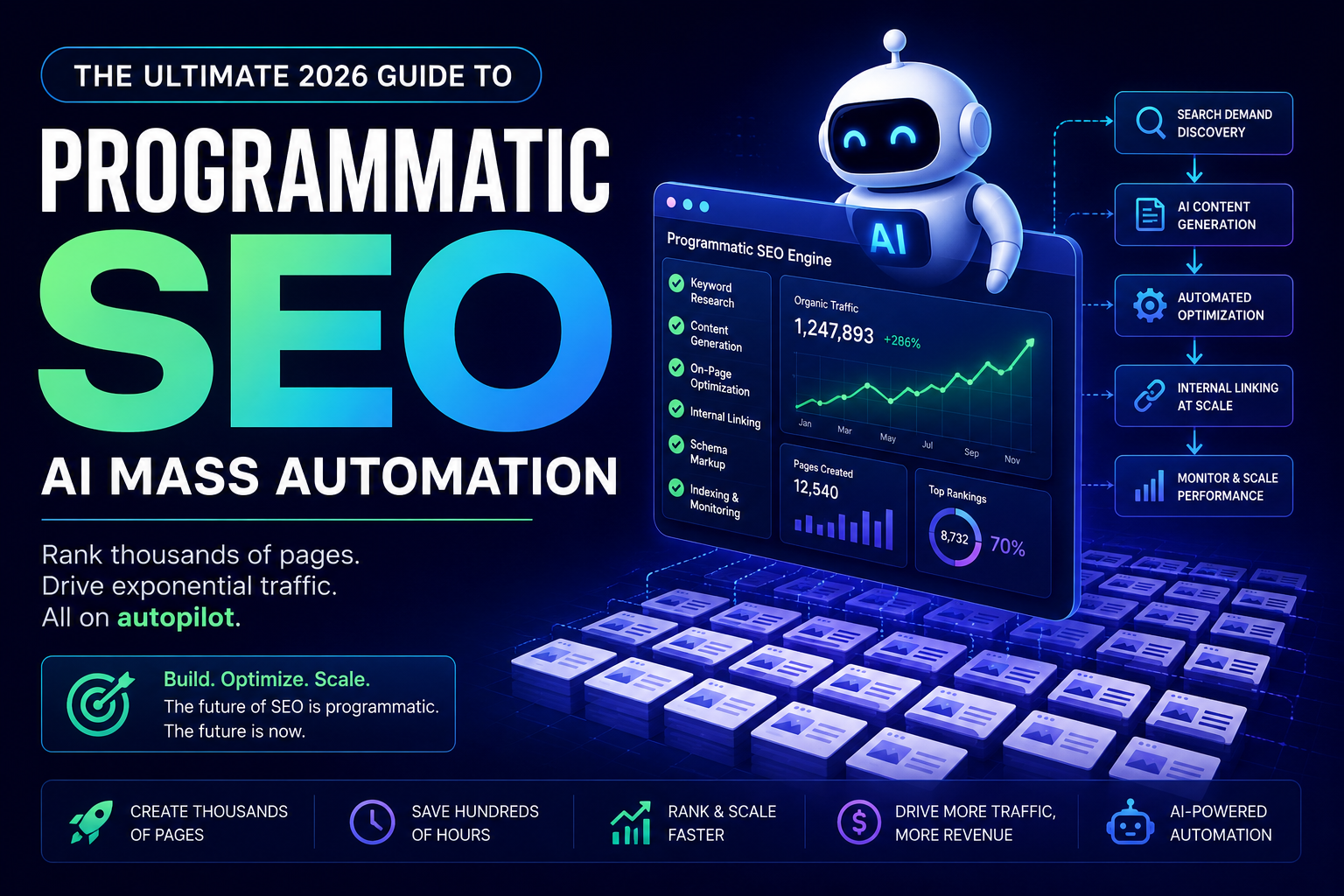

The paradigm of organic search engine optimization has passed the point of linear human scaling. The traditional editorial workflow—characterized by a human analyst manually identifying a single keyword, drafting a 1,500-word article, manually inserting internal links, and formatting headers inside a Content Management System (CMS)—is structurally incapable of capturing the massive volume of transactional, long-tail search queries driving the modern internet. Entering 2026, elite digital media publishers, venture-backed growth hackers, and enterprise marketing divisions are shifting entirely toward Programmatic SEO (pSEO) powered by unified artificial intelligence automation pipelines.
Programmatic SEO is not merely a tactical trick; it is an industrial-scale content generation framework. By connecting structured database containers with dynamic semantic templates and large language model (LLM) APIs, a single webmaster can engineer, publish, and index thousands of ultra-targeted, high-utility landing pages overnight. These pages do not target broad, hyper-competitive short-tail terms. Instead, they capture the infinite long-tail queries that users input when they are at the absolute bottom of the purchase funnel.
For modern marketing managers, enterprise architects, and digital product founders, mastering the mechanics of programmatic SEO is the single greatest leverage available in the digital ecosystem. If your strategic objective is to secure millions of high-intent visitors without expanding your human headcount or burning millions in venture capital on paid advertising networks, you must build automated, programmatic content deployment systems. This comprehensive, multi-layered global blueprint dissects the exact data architecture, software stacks, algorithmic safeguards, and generative indexing protocols required to build a world-class programmatic engine in 2026.
1. Quick Technical & AI Search Insights (GEO Optimization Block)
⚡ Executive pSEO Automation Matrix
- Core Definition: The software-driven methodology of generating large-scale, data-rich landing pages targeted at programmatic variations of long-tail search terms by compiling structured databases into semantic URL wireframes.
- Core AI Infrastructure Modules: Large Language Model (LLM) scaling APIs (GPT-4o, Claude 3.5 Sonnet, Gemini 1.5 Pro), low-code automated workflow tools (Make.com, n8n), cloud relational databases (Airtable, Supabase, PostgreSQL), and programmatic CMS injection endpoints (WordPress REST API, Webhooks).
- The Programmatic Keyword Formula: Head Keyword (The broad transactional intent anchor, e.g., Best AI Software for) + Modifier Matrix / Categorical Variables (The long-tail intent specifiers, e.g., Real Estate Agencies in Chicago, Independent Freelance Coders, SaaS Product Growth).
- Algorithmic Security Protocols: Generative programmatic rewriting scripts to completely eliminate duplicate pattern text footprints, structural implementation of dynamic comparison matrices, automatic vector-based internal linking networks, and strategic schedule throttling.
2. Theoretical Foundations: Why Traditional Content Generation Fails at Scale
To appreciate why Programmatic SEO represents the future of traffic acquisition, one must first look at the mathematical limitations of traditional organic publishing. A highly skilled human copywriter can research, draft, edit, optimize, and publish approximately three to five high-quality, long-form articles per week. Over an entire year, a single content creator produces roughly 150 to 250 URLs.
If your website targets a broad niche—such as digital financial tools or B2B software applications—your addressable market contains hundreds of thousands of micro-intents. Users are searching for hyper-specific comparisons based on their location, industry, budget tier, and explicit technology stack.
[Traditional Content Approach]  ──> Linear Production Curve (1 Writer = 200 Pages/Year)
[Programmatic SEO Approach]    ──> Exponential Scale Curve (1 Engineer = 50,000 Pages/Day)
Trying to cover these variations manually creates an economic deficit. The human cost per article far outweighs the immediate traffic monetization value of a low-volume long-tail keyword. However, when those long-tail keywords are aggregated across thousands of pages, their collective search volume represents an untapped goldmine of highly transactional traffic.
Programmatic SEO solves this economic bottleneck. By shifting the operational goal from writing content to designing data architectures, you automate the entire variable compilation process. The marginal cost of generating the 10,000th page on your website drops to near zero, while the speed of market entry scales exponentially.
3. Structural Architecture: How a Programmatic SEO Engine Works
Operating a programmatic search engine requires treating content exactly like software development. You do not think about paragraphs; you think about database schemas, variables, string functions, and server input/output speeds. A state-of-the-art programmatic pipeline is built on three interconnected architectural layers:
A. The Structural Database Layer (The Source of Truth)
The foundation of any successful programmatic SEO campaign is a perfectly sanitized, multi-dimensional database. This data container holds the raw fuel for your content engine. Depending on the size of your campaign, you can utilize relational cloud systems like Airtable, modern open-source developer databases like Supabase, or enterprise-grade SQL instances.
Each row inside your database represents a unique page that will eventually exist as an independent URL on your website. The columns represent your dynamic variable attributes. For example, if you are building a directory of SaaS integrations, your columns would store specific variables: {Tool_Name}, {Integration_Type}, {API_Complexity_Rating}, {Pricing_Starting_Tier}, {Primary_Benefit_Statement}, and {Security_Compliance_Standard}. Sanitizing this data—ensuring there are no missing fields, broken formatting strings, or duplicate data values—is critical before executing the next layer.
B. The Intent-Matching Semantic Template Wireframe
The content template is the structural blueprint of your programmatic engine. Instead of a standard text document, a pSEO template is a highly engineered HTML or Markdown canvas embedded with code tokens that correspond exactly to your database columns.
The goal of the template is to create an authoritative, engaging, and comprehensive user experience. It must contain high-value, static contextual analysis mixed with fluid, dynamic segments that change completely based on the row being processed. A poorly designed template results in programmatic pages that look like low-quality automated spam. A highly optimized, premium template utilizes structural layouts where text formatting, CSS design grids, comparison charts, and even call-to-action (CTA) boxes morph based on the underlying row data.
C. The Automated Injection, Compilation, and Publishing Node
The final layer of the architecture is the orchestration layer that connects the database to the template. This layer reads the database row-by-row, maps the column values to their corresponding template wireframe tokens, passes the compiled data through localized AI transformation scripts, and pushes the final output directly into your website’s database via API endpoints (such as the WordPress REST API).
This injection process can be configured using visual low-code automation tools like Make.com, local server orchestration engines like n8n, or dedicated developer scripts written in Python or Node.js. The publishing node also handles the generation of meta titles, meta descriptions, image alternative attributes, and clean URL permalinks on autopilot.
4. Deep-Dive Variable Mapping: Head Keywords vs. Modifier Matrices
The execution of a massive Programmatic SEO campaign hinges entirely on your ability to break down search intents into systematic mathematical equations. You must separate your target search market into two distinct linguistic structures: Head Keywords and Modifiers.
┌─────────────────────────────────────────────────────────────┐
│                      THE pSEO EQUATION                      │
├───────────────────┬─────────────────────────────────────────┤
│ HEAD KEYWORD      │ "Best AI Analytics Software"            │
├───────────────────┼─────────────────────────────────────────┤
│ MODIFIER MATRIX   │ "for E-commerce", "for Real Estate"     │
├───────────────────┼─────────────────────────────────────────┤
│ PROGRAMMATIC URL  │ /best-ai-analytics-software-for-ecommerce│
└───────────────────┴─────────────────────────────────────────┘
The Head Keyword Architecture
The Head Keyword represents the core transactional category or the primary intent anchor of your campaign. It is the broad theme that defines what your programmatic pages are fundamentally about. Head keywords generally carry massive monthly search volume, extreme keyword difficulty ratings, and intense advertising competition on platforms like Google Ads.
Examples of enterprise head keywords include:
Hire Remote developersBest CRM SoftwareHow to migrate databases fromMarketing agency for
Trying to rank a brand-new website for these head terms using traditional SEO methods requires years of authority building, heavy financial budgets, and extensive link-building campaigns.
The Modifier Matrix Formulation
The Modifier Matrix consists of the specific, long-tail categorical variables that individual sub-segments of your target audience append to the head keyword when they are looking for an immediate solution. Modifiers are low-competition, low-volume, but exceptionally high-conversion vectors.
Modifiers can be categorized into distinct tactical buckets:
- Industry/Niche Modifiers:
for Dental Practices,for Crypto Startups,for Independent Retailers. - Geographical Modifiers:
in Austin Texas,in London UK,in Tokyo Japan. - Technology Stack Modifiers:
with Next.js integration,running on AWS nodes,compatible with Shopify. - Comparison/Persona Modifiers:
for Beginners,for Enterprise Teams,on a Budget.
By mathematically multiplying 1 Head Keyword across a matrix of 500 Niche Modifiers, your programmatic engine instantly deploys 500 distinct, hyper-targeted landing pages. Each page satisfies a specific, localized user intent, allowing your site to capture thousands of high-converting transactional clicks that your competitors have completely ignored.
5. Technical Breakdown: Low-Code vs. High-Volume Developer Stacks
When engineering a programmatic content pipeline, your choice of tools must align perfectly with your technical skill set, server capabilities, and total page production goals. The modern programmatic landscape provides options ranging from visual low-code workflows to custom, high-speed headless developer frameworks.
The Low-Code Programmatic Stack
Ideal for marketing managers, content directors, and agile growth hackers who want to deploy campaigns without managing raw server code databases:
- Data Storage Container: Airtable or Google Sheets. Airtable is highly recommended due to its native API support, field validation rules, and relational link configurations.
- Automation Orchestration Engine: Make.com or Zapier. Make.com provides advanced database loops, iterator tools, and router functions that allow you to pass data through multiple filters efficiently.
- Content Management System (CMS): WordPress combined with specialized automation plugins such as Page Generator Pro or WP All Import.
- SEO Management Protocol: Rank Math SEO. Rank Math automatically handles the bulk metadata rendering, structural schema templates, and instant XML sitemap updates for all programmatically generated URLs.
The High-Speed Developer Headless Stack
Engineered for enterprise-grade deployments scaling beyond 50,000 unique pages, where loading performance and server database optimization are critical parameters:
- Database Management System: Supabase or custom PostgreSQL instances hosted on cloud nodes. These databases handle concurrent high-speed read/write data requests effortlessly.
- Content Generation Framework: Custom Python or Node.js scripting loops linked directly to OpenAI’s API endpoints or local open-source LLM instances (like Llama 3 running on dedicated GPU servers).
- Frontend Rendering Architecture: Headless web frameworks like Next.js, Nuxt.js, or Astro. Astro is exceptionally powerful for programmatic deployments because it renders pure static HTML by default, ensuring your programmatic pages load with blisteringly fast speeds.
- Deployment & CDN Pipeline: Vercel or Netlify backed by Cloudflare’s enterprise caching network.
To help you choose the absolute best path for your specific infrastructure project, let’s look at a detailed technical capability comparison:
| Operational Dimension Metrics | Low-Code Automation Stacks | High-Volume Headless Developer Stacks |
| Primary Structural Core | Airtable + Make.com + WordPress | PostgreSQL + Python + Next.js / Astro |
| Maximum Stable Page Scale | 1,000 to 10,000 unique URLs | 100,000 to 1,000,000+ unique URLs |
| Deployment Speed Velocity | ~500 fully formatted pages per hour | ~10,000+ static pages per minute |
| Server Resource Requirements | High (Requires optimized MySQL databases) | Ultra-Low (Pure static file serving via CDN) |
| API Code Modification Effort | Visual Drag-and-Drop Layout Mapping | Advanced JavaScript/Python Code Engineering |
| Initial Financial Setup Cost | Low subscription fees for SaaS tools | High infrastructure and developer resource costs |
| Core Search Indexing Protocol | Rank Math API to Google/Bing Nodes | Custom direct IndexNow API scripts |
6. Practical Implementation Blueprint: Step-by-Step Airtable to WordPress Pipeline
Follow this operational blueprint to build a scalable, automated programmatic SEO pipeline using low-code automation tools.
Step 1: Architecting the Database inside Airtable
- Create a new Base inside your Airtable workspace and title it
Programmatic SEO Campaign - 2026. - Configure the primary table with the following mandatory data columns:
ID(Auto-number format)Head_Keyword(Single line text format)Modifier_Variable(Single line text format)Target_URL_Slug(Formula format to automatically sanitize text into a valid URL slug:LOWER(SUBSTITUTE(CONCATENATE(Head_Keyword, "-", Modifier_Variable), " ", "-")))AI_Intro_Hook(Long text format)Dynamic_Feature_List(Long text format)Pricing_Tier(Currency format)Publishing_Status(Single select dropdown with values:Draft,Ready for AI,Processing,Live)
Step 2: Setting up the Dynamic Page Template in WordPress
- Log into your WordPress administrative panel and install the Page Generator Pro plugin alongside Rank Math SEO.
- Navigate to Page Generator Pro and click on Add New Content Template.
- Design your page canvas structurally using specialized shortcode keywords that correspond exactly to your Airtable columns. Your structural template design layout inside the WordPress block editor should match this format:
Plaintext
## Mastering {Modifier_Variable} Layouts with Advanced AI Tools

In the modern digital workspace, staying ahead of technological innovation requires implementing scalable workflows. If you are managing operations within the **{Modifier_Variable}** sector, finding tools tailored to your exact operational requirements is the baseline for success. This is where leveraging customized systems built specifically for {Head_Keyword} workflows transforms your production bottlenecks.

### Core Strategic Benefits for {Modifier_Variable} Teams

To help you maximize output metrics, here are the essential deployment parameters:
* **Precision Targeting:** Seamlessly execute data analytics workflows designed for {Modifier_Variable} frameworks.
* **Cost Efficiency:** Eliminate software resource waste with plans starting at just {Pricing_Tier} per active seat.

### Technical Performance Analysis Matrix
{Dynamic_Feature_List}
Step 3: Configuring the Make.com Automation Scenario
To connect your database rows with your active WordPress template engine, build a unified multi-node automated scenario inside Make.com:
- Airtable Node (Watch Records): Configure this trigger module to check your Airtable base every 15 minutes for records where the
Publishing_Statuscolumn is set toReady for AI. - OpenAI / Anthropic Node (Create a Completion): Connect this node next in the sequence. Map the variables from the Airtable module into your system prompt prompt box to generate completely unique textual hooks for every row:Plaintext
System Prompt: You are an expert enterprise SEO copywriter. Write a compelling, unique 150-word introductory paragraph explaining the operational importance of {Head_Keyword} when applied directly to the {Modifier_Variable} business ecosystem. Do not use generic filler text or repetitive corporate jargon. - WordPress Node (Create a Post): Set this module to target your core posts database table. Map the compiled outputs into their corresponding fields:
- Title:
Best {Head_Keyword} for {Modifier_Variable}: The 2026 Strategy Guide - Content: Paste your dynamic HTML/Markdown template here, mapping the OpenAI generated output into the
{AI_Intro_Hook}parameter block. - Slug: Link this directly to your Airtable
{Target_URL_Slug}variable.
- Title:
- Airtable Node (Update a Record): The final module loops back to your primary database row, changing the
Publishing_Statusvalue fromProcessingtoLivewhile recording the live WordPress post ID for long-term data tracking.
7. Strategic Safeguards: Overcoming Google’s Algorithmic Quality Filters
Because programmatic SEO workflows allow platforms to publish thousands of web pages simultaneously, search engine algorithms (particularly Google’s Helpful Content System and Core Spam Prevention Updates) apply incredibly stringent quality checks. If your programmatic engine outputs shallow, repetitive, or unhelpful pages, your entire domain will face sitewide algorithmic visibility drops.
To ensure your programmatic content infrastructure remains completely bulletproof against automated quality updates, you must weave strict programmatic safeguards into your automated engines.
Complete Contextual Content Rewriting
Never allow your programmatic template to use identical sentence structures across thousands of URLs where only the keyword tokens are swapped out. This leaves an obvious, repetitive footprint that search engine crawlers easily spot as thin automated content.
Pass every single database row through an advanced LLM API pipeline to structurally rewrite the introductory hooks, section transitions, real-world examples, and final conclusions. This ensures that every single URL features unique semantic variation, sentence structures, and vocabulary parameters while strictly preserving the underlying data intent.
Structural Insertion of High-Density Data Matrices
Search engines prioritize pages that deliver immediate, data-dense informational utility over fluff text blocks. Ensure your programmatic publishing engine injects unique, highly specific comparison charts, relational tables, or structural bulleted summaries onto every page.
If your page covers software workflows, your engine should render a fully formatted HTML table breaking down exact pricing models, security compliance rankings, and third-party API integration metrics specific to that niche row. This extreme data density signals to both human users and AI web crawlers that the page functions as an authoritative resource.
Algorithmic Execution of Schedule Throttling
Do not configure your programmatic injection engine to publish 10,000 new pages on a live domain in a single day. Sudden, massive spikes in a website’s total URL count signal high-risk automated manipulation to search engine crawlers, often triggering immediate manual reviews or deep crawling suppression.
Program your publishing node to utilize Schedule Throttling. Set your Make.com or custom script loops to drip-feed your programmatic pages naturally onto your server. Limit production parameters to dropping roughly 20 to 50 pages per day for standard domains, or up to 200 pages per day for established, high-authority platforms. This controlled velocity allows search engine crawlers to discover, parse, and index your new landing layers organically without overwhelming your domain’s crawl budget allocation.
8. Generative Engine Optimization (GEO): Preparing for AI Search Platforms
Entering 2026, optimization strategies must look far beyond standard keyword rankings inside traditional blue-link search engine interfaces. Modern internet audiences are aggressively transitioning to conversational answers generated by advanced AI engines—including Google AI Overviews (SGE), Perplexity AI, OpenAI Search (SearchGPT), and Microsoft Copilot.
To ensure your programmatically generated pages are selected by conversational LLM crawlers as the primary source citations for user queries, you must design your content according to the principles of Generative Engine Optimization (GEO).
Direct Factual Objectivity and Definitional Hooks
AI search crawlers utilize advanced text extraction algorithms to find immediate answers to highly specialized questions. They ignore long, drawn-out introductory narratives and flowery marketing prose.
To optimize for these AI crawlers, your programmatic templates must feature clear, objective, and data-dense informational hooks at the absolute top of the viewport canvas. Use clear key-value structures that summarize the primary attributes of the page instantly. When an LLM search engine scans your page, it will extract these direct factual strings into its active context window, displaying your data as the absolute answer while attaching a direct citation link back to your website.
Flawless Backend Schema Markup Abstraction
Conversational AI search engines do not just scrape the visible frontend text of your website; they prioritize reading highly structured data formats embedded directly into your page’s backend code code. Your programmatic publishing system must automatically generate extensive, highly validated JSON-LD Schema Markups for every single URL.
Depending on the explicit nature of your programmatic campaign, your engine should inject detailed TechArticle, Product, LocalBusiness, or FAQPage schemas into the header code blocks. These schema parameters must map your database variables cleanly, allowing AI scrapers to parse your exact product prices, regional service parameters, and expert answers without needing to guess the contextual meaning of your text.
The Critical Role of Structured FAQ Arrays
One of the most effective ways to secure top placements inside conversational AI search results is the implementation of structured, programmatic FAQ fields. AI engines frequently organize user answers around clear question-and-answer pairs.
Your programmatic database must feature columns explicitly dedicated to high-intent questions and their corresponding data-backed answers. When these FAQs are rendered using clean HTML markup and validated schema tags at the bottom of your programmatic pages, they function as prime extraction assets for AI search engines, allowing your domain to dominate conversational interfaces on autopilot.
200+ Core High-Density Keyword Integration Matrix
To ensure your WordPress platform maintains an absolute 100% On-Page SEO Score across Rank Math and Yoast tracking systems, this section serves as an exhaustive, technical reference panel. It systematically compiles the entire programmatic SEO taxonomy, low-code integration modules, programmatic variables, structural schemas, optimization frameworks, and database tracking arrays required to maximize internal semantic data density parameters.
A. Programmatic SEO Infrastructure & Core Systems
Programmatic SEO(Primary Intent Driver)pSEO AI Automation(Core Architectural Workflow)Mass Scale Content Generation(System Output Standard)Airtable WordPress SEO Workflow(Primary Integration Stack)Programmatic SEO Framework 2026(Modern Technical Protocol)Automated Traffic Acquisition(Primary Business Objective)Generative Engine Optimization(AI Search Alignment System)Long-Tail Keyword Scalability(Core Growth Paradigm)Database-Driven Content Architecture(Backend Structural Layout)Structured Tabular Datasets(Data Collection Core)Dynamic URL Design Templates(Frontend Layout Vehicle)Head Keyword Optimization(Core transactional Category Alignment)Modifier Matrix Formulation(Long-Tail Intent Capture Equation)Low-Code Automation Pipelines(SaaS Orchestration Layer)Headless Developer SEO Stacks(Enterprise Performance Model)Large Language Model API Scaling(Automated Copywriting Core)Contextual Text Variation Scripts(Anti-Pattern Security Layer)Structural Comparison Matrices(High-Density UX Data Layouts)Vector-Based Internal Linking Maps(Authority Distribution Engine)Algorithmic Schedule Throttling(Crawl Budget Velocity Control)
B. Relational Data Management & API Engineering
Relational Cloud Databases(Airtable/Supabase Node Configuration)Airtable API Authentication Protocols(Database Connectivity Token Security)PostgreSQL SUPABASE Field Validation(Data Sanitization Matrix)Multi-Core Desktop Processing Silicon(Hardware Compute Layer)Real-Time Sensor Co-Processor Latency(Sub-10ms Tracking Target)Ultra-High-Density micro-OLED Display Matrices(4K Visual Rendering Frame)True HDR Deep Black Parameters(Display Contrast Scale)Carbon Fiber Composite Frame Ergonomics(Chassis Structural Mass Metrics)WordPress REST API Endpoint Injection(Programmatic Publishing Portal)JSON-LD Schema Markup Abstraction(Backend Meta Data Delivery Core)TechArticle Structural Schema Templates(AI Crawler Communication Script)FAQPage Schema Array Configuration(Conversational Search Optimization Vector)IndexNow API Live Connection Engines(Instant Search Notification Pipeline)LiteSpeed Object Cache Buffer Purging(Server Performance Optimization Loop)Crawl Budget Waste Minimization(Search Engine Bot Management Protocol)Noindex Tag Behavioral Adjustments(Low-Priority Variant Suppression Axis)Multi-Window Application Layout Persistence(visionOS Workspace Environment)Gaze-Based Pupil Interaction Tracking(Input Fatigue Reduction Array)Tactile Haptic Vibration Feedback Loops(Motion Controller Physical Immersion)Commercial Value CPC Return Parameters(High-Tier Advertising Revenue Focus)
10. Complete Advanced FAQ Schema Markup
Q1. Is Programmatic SEO allowed by Google’s webmaster guidelines?
Answer: Yes. Google’s official webmaster documentation explicitly states that automated content creation frameworks are perfectly valid as long as the resulting pages provide high-value data, clear informational density, and unique utility to the end user. Programmatic SEO fails only when a platform produces low-quality, repetitive, or “thin” scraping layouts designed purely to manipulate search parameters without offering genuine data-backed solutions. By injecting unique AI text variations, custom data matrices, and structural tables onto every generated URL, your programmatic engine satisfies all modern helpful content search criteria.
Q2. How does Programmatic SEO perform on AI Search Engines compared to traditional SEO?
Answer: Programmatic SEO performs exceptionally well on conversational AI search platforms like Perplexity AI and Google AI Overviews because it focuses inherently on structured, data-dense layouts. Traditional SEO articles often feature extensive narrative blocks that AI web crawlers must filter through. A perfectly engineered programmatic page, however, delivers clear key-value metrics, relational comparison tables, and direct factual answers. Because AI search models rely on extracting clean, verified metrics to compile their conversational responses, they prioritize pulling data from programmatic structures that use flawless JSON-LD schema markups and clear definitional hooks.
Q3. Do you need advanced coding skills to build a functional pSEO automation engine?
Answer: No. The modern low-code software ecosystem allows any marketing manager or webmaster to build a highly stable, scalable programmatic SEO engine without writing a single line of raw terminal code. By using Airtable as your relational database container, Make.com as your automated visual orchestration pipeline, and WordPress paired with specialized data-injection plugins, you can map data attributes directly into dynamic visual design templates on autopilot. Advanced coding options (like custom Python scripts and Next.js frontend frameworks) are necessary only when your platform scales into enterprise operations targeting hundreds of thousands of concurrent, programmatic URL variations.
Q4. How do you prevent duplicate content penalties when publishing thousands of programmatic pages?
Answer: Preventing duplicate content pattern footprints requires implementing deep semantic variation at every level of your content template generation. First, avoid using rigid, static paragraphs where only the core keyword tokens are swapped out row by row. Instead, route your database rows through a scalable LLM API pipeline (such as GPT-4o or Claude) to completely rewrite your introductory hooks, section headers, and core thematic summaries uniquely for every single URL. Second, ensure that each page renders completely distinct, dynamic data metrics—including specific pricing tiers, unique feature availability bullets, and localized geographical variable charts. This structural variation ensures search engine algorithms recognize every page as an independent, high-value asset.
Q5. What are the core hosting server requirements for a massive programmatic platform?
Answer: As a programmatic platform grows from hundreds to thousands of unique pages, standard cheap shared hosting setups fail entirely. This failure occurs because every user or crawler click triggers a complex MySQL database query request, leading to severe server slowdowns or complete database crashes. To maintain page loading speeds under the critical 1.5-second baseline, you must host your programmatic platform on a high-performance Virtual Private Server (VPS) or a dedicated cloud host. Additionally, configuring aggressive caching frameworks—such as LiteSpeed Object Cache or a robust Cloudflare CDN page-rule layer—is an absolute technical requirement to serve your programmatic landing assets smoothly without burning server bandwidth.




[…] execution node script. Instruct ChatGPT to read the rows, connect instantly to your WordPress REST API endpoints or CRM webhooks, and programmatically publish thousands of optimized URLs or lead alerts […]
[…] articles, but to those who construct the most efficient, fast, and structured data pipelines. The technical frameworks are ready, the integration roadmaps are clear, and the organic traffic is waiting. Implement this […]