
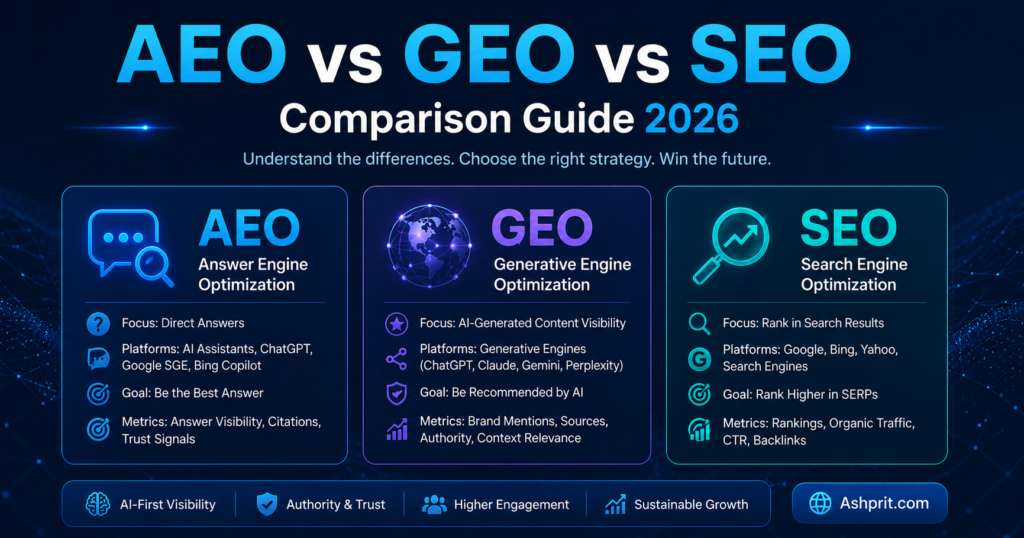
AEO vs GEO vs SEO are three important strategies for improving online visibility in 2026. While SEO helps websites rank in search engines, AEO helps content appear in answer engines and GEO helps AI systems discover and cite content.
AEO vs GEO vs SEO is one of the most important topics in modern digital marketing.
Table of Contents
Introduction
For more than two decades, Search Engine Optimization (SEO) was the primary way websites attracted visitors online.
The process was simple.
A user searched for something on Google, clicked a result, visited a website, and consumed the information.
Businesses invested heavily in SEO because ranking on the first page of Google meant more traffic, more leads, and more sales.
Today, search is changing faster than ever.
People no longer rely only on traditional search engines.
Millions of users now ask questions directly to ChatGPT, Gemini, Claude, Perplexity, Microsoft Copilot, and Google AI Overviews.
Instead of browsing through multiple websites, users increasingly prefer direct answers.
This shift is creating confusion for website owners, bloggers, marketers, and businesses.
Many people are asking:
- Is SEO still relevant?
- What is AEO?
- What is GEO?
- Which strategy should I focus on?
- How do AI search engines discover content?
The answer is not choosing one strategy over another.
The future belongs to websites that understand the differences between SEO, AEO, and GEO and use them together.
In this guide, you will learn exactly how these three approaches work, how they differ, and how to build a content strategy that remains effective in the age of AI-powered search.
Quick Answer
SEO, AEO, and GEO are three different approaches to improving online visibility.
SEO (Search Engine Optimization)
SEO focuses on helping webpages rank higher in traditional search engines like Google and Bing.
AEO (Answer Engine Optimization)
AEO focuses on helping answer engines provide your content as direct answers to user questions.
GEO (Generative Engine Optimization)
GEO focuses on helping AI systems such as ChatGPT, Gemini, Claude, and Perplexity understand, trust, and reference your content.
In 2026 and beyond, businesses should not choose between SEO, AEO, and GEO.
They should combine all three.
What Is SEO?
SEO stands for Search Engine Optimization.
It is the practice of improving a website so search engines can understand its content and rank it higher in search results.
For years, SEO has been the foundation of digital marketing.
Imagine you own a blog about AI tools.
A user searches:
“Best AI tools for content creation”
Google analyzes thousands of webpages and decides which pages deserve to appear first.
SEO helps increase the chances that your page appears among those results.
The biggest difference between AEO vs GEO vs SEO is how each strategy targets users.
How SEO Works
Traditional SEO focuses on several factors:
Keywords
Keywords help search engines understand what a page is about.
For example:
- AI tools
- SEO tools
- Blogging tips
- GEO optimization
Content Quality
Google wants to show useful content.
Pages that provide detailed, accurate, and valuable information usually perform better.
Backlinks
Backlinks are links from other websites.
When trusted websites link to your content, Google sees it as a positive signal.
User Experience
Google considers:
- Page speed
- Mobile friendliness
- Navigation
- Readability
A better user experience often improves rankings.
Technical SEO
Technical SEO includes:
- Site structure
- XML sitemaps
- Indexing
- Structured data
- Security
These factors help search engines crawl websites efficiently.
Benefits of SEO
SEO offers several advantages:
- Long-term traffic
- Brand visibility
- Lead generation
- Sales opportunities
- Authority building
Even in the age of AI, SEO remains extremely important.
Limitations of SEO
SEO is powerful, but it has limitations.
A user must:
- Search
- See results
- Click a link
- Visit a website
AI search is changing this process.
Many users now receive answers without clicking a website at all.
This is where AEO becomes important.
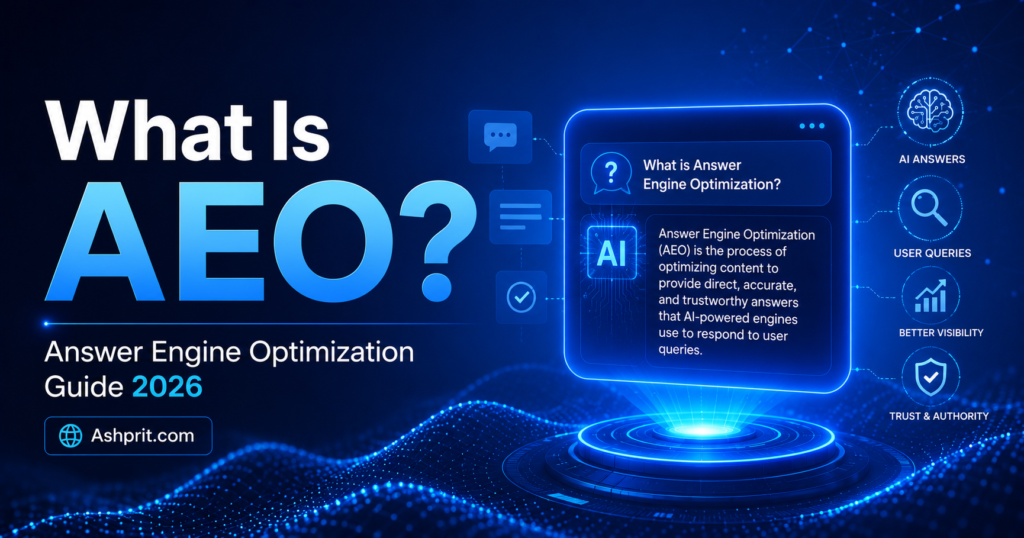
What Is AEO?
AEO stands for Answer Engine Optimization.
It focuses on helping answer engines provide your content as a direct answer.
Instead of showing users a list of links, answer engines generate a response.
Examples include:
- Google AI Overviews
- Bing Copilot
- Siri
- Alexa
- Voice assistants
If you want to learn more about Answer Engine Optimization, read our complete guide on What Is AEO (Answer Engine Optimization). The guide explains how AI Overviews, voice search, and answer engines use content to provide direct answers to users.
Many marketers focus only on SEO, but AEO vs GEO vs SEO should be used together.
Why AEO Exists
People increasingly search using questions.
For example:
“What is AEO?”
Instead of browsing multiple websites, users want an immediate answer.
AEO helps content appear in those responses.
Example of AEO
Imagine two websites.
Website A says:
“Answer Engine Optimization has become increasingly important in the digital marketing industry.”
Website B says:
“AEO stands for Answer Engine Optimization. It helps websites appear in AI-generated answers and search summaries.”
Which answer is easier for an answer engine to use?
Website B.
The answer is direct, clear, and easy to extract.
How AEO Works
AEO focuses on:
Direct Answers
Provide answers immediately.
FAQs
Answer common questions.
Question-Based Headings
Examples:
- What Is AEO?
- How Does AEO Work?
- Why Is AEO Important?
Structured Data
Schema helps answer engines understand content.
Voice Search
Many voice assistants rely on answer-engine principles.
Benefits of AEO
AEO can improve visibility in:
- Google AI Overviews
- Voice search
- Featured snippets
- AI-powered search interfaces
Limitations of AEO
AEO focuses primarily on answers.
It does not fully address how AI systems understand, summarize, and recommend information across multiple sources.
This is where GEO becomes important.
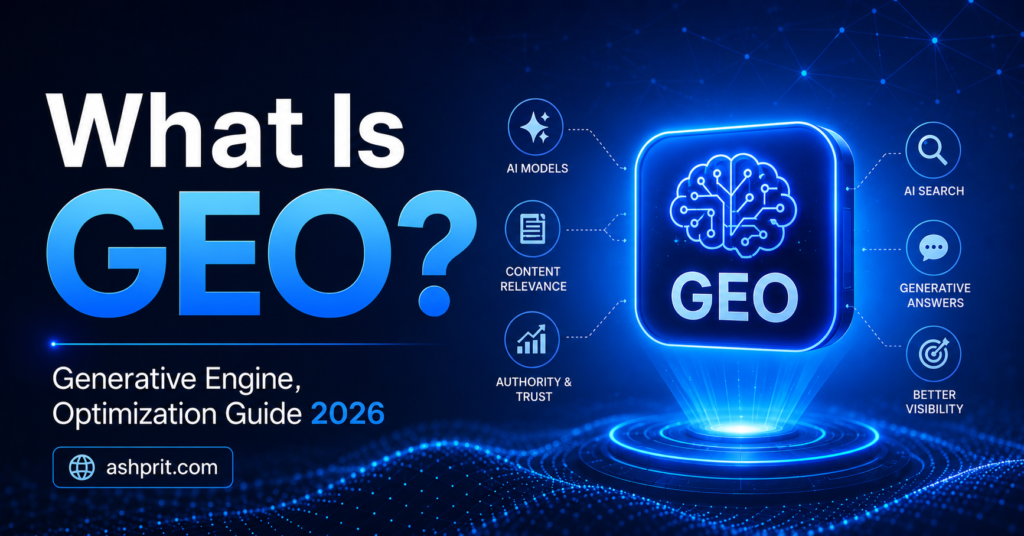
What Is GEO?
GEO stands for Generative Engine Optimization.
It is one of the newest concepts in digital marketing.
GEO focuses on optimizing content for AI-powered systems that generate responses.
Examples include:
- ChatGPT
- Gemini
- Claude
- Perplexity
- Future AI search platforms
To understand how AI systems such as ChatGPT, Gemini, Claude, and Perplexity discover and reference content, explore our detailed guide on What Is GEO (Generative Engine Optimization).
In 2026, AEO vs GEO vs SEO will become essential for online growth.
Why GEO Matters
AI systems are changing how information is discovered.
Instead of returning links, they generate answers.
Users increasingly ask:
- What are the best AI tools?
- How does GEO work?
- Which SEO strategy should I use?
AI systems create responses using information they understand and trust.
GEO helps improve the chances that your content becomes part of those responses.
Example of GEO
Imagine someone asks ChatGPT:
“What is the difference between SEO and GEO?”
ChatGPT generates a response.
The content used to build that response comes from sources the model understands and trusts.
GEO increases the likelihood that your content contributes to those answers.
How GEO Works
GEO focuses on:
Topical Authority
Covering a topic comprehensively.
Context
Helping AI understand relationships between ideas.
Entity Optimization
Clearly defining people, brands, products, and concepts.
Structured Information
Organized content is easier for AI systems to process.
Expertise
Trustworthy content performs better.
Benefits of GEO
GEO helps improve visibility across:
- ChatGPT
- Gemini
- Claude
- Perplexity
- AI-powered search experiences
Limitations of GEO
GEO alone does not replace SEO.
You still need traditional search traffic.
The strongest strategy combines SEO, AEO, and GEO.
AEO vs GEO vs SEO: Quick Comparison
| Feature | SEO | AEO | GEO |
|---|---|---|---|
| Main Goal | Rank webpages | Provide answers | Influence AI-generated responses |
| Focus | Search engines | Answer engines | Generative AI systems |
| Primary Platform | Google, Bing | AI Overviews, Voice Search | ChatGPT, Gemini, Claude |
| Success Metric | Traffic | Answer visibility | Citations and references |
| Optimization Style | Keywords | Questions and answers | Context and authority |
| User Journey | Search → Click | Search → Answer | AI → Recommendation |
How Search Has Changed
To understand why SEO, AEO, and GEO matter, it helps to understand how search has evolved.
Search Era 1: Traditional Search
Users typed keywords.
Google returned webpages.
Traffic flowed to websites.
SEO dominated.
Search Era 2: Featured Snippets and Voice Search
Users began asking questions.
Google started providing direct answers.
Voice assistants became popular.
AEO became increasingly important.
Search Era 3: AI-Powered Search
Users now ask:
“What is the best AI tool for beginners?”
Instead of showing links, AI systems generate complete responses.
This is where GEO enters the picture.
The Future
The future of search is not:
SEO vs AEO vs GEO
The future is:
SEO + AEO + GEO
Websites that combine all three approaches will have the greatest visibility across traditional search engines, answer engines, and AI-powered platforms.
How Google Finds Content
Before understanding AEO and GEO in depth, it’s important to understand how Google discovers information.
Many beginners believe Google simply reads webpages and ranks them.
In reality, the process is far more complex.
Google generally follows three stages:
Crawling
Googlebot visits webpages and discovers new content.
Indexing
The content is analyzed and stored in Google’s index.
Ranking
Google decides where a page should appear for a search query.
For example:
If someone searches:
“Best AI SEO tools”
Google evaluates:
- Relevance
- Content quality
- User experience
- Authority
- Freshness
Then it decides which pages deserve visibility.
Traditional SEO focuses heavily on improving performance in this process.
How Google AI Overviews Work
Google AI Overviews represent one of the biggest changes in search history.
Instead of showing only links, Google now generates summarized answers.
For example:
A user searches:
“What is the difference between AEO and GEO?”
Instead of displaying only websites, Google may generate a complete explanation at the top of the page.
This changes the game.
Now websites need two things:
Traditional Visibility
Ranking in organic search.
AI Visibility
Being included in AI-generated summaries.
This is where AEO and GEO become extremely important.
Why AI Overviews Matter
AI Overviews reduce the number of clicks users make.
Instead of opening five websites, users often receive an answer instantly.
For businesses, this creates a challenge.
The goal is no longer just ranking.
The goal is becoming part of the answer.
How ChatGPT Finds Information
One of the most common questions today is:
“How does ChatGPT decide what information to use?”
The answer depends on several factors.
ChatGPT works differently from Google.
Instead of ranking webpages, it focuses on understanding information.
It prefers content that is:
- Clear
- Structured
- Educational
- Well organized
- Context-rich
Example
Imagine two explanations.
Example A
“SEO has become important in recent years because businesses increasingly rely on digital marketing strategies.”
Example B
“SEO (Search Engine Optimization) helps websites rank higher in search engine results and attract more organic traffic.”
Most AI systems find Example B easier to understand because it provides a direct definition.
This is why answer-first content performs better in AI environments.
What ChatGPT Prefers
ChatGPT generally favors content containing:
Clear Definitions
Example:
“What is GEO?”
A direct answer is easier to understand than a lengthy introduction.
Structured Headings
Good examples:
- What Is GEO?
- Why GEO Matters
- Benefits of GEO
Topic Clusters
Websites that publish multiple articles about a subject demonstrate expertise.
For example:
A website publishing:
- What Is GEO?
- GEO vs SEO
- GEO Ranking Factors
- GEO Tools
appears more authoritative than a website with only one GEO article.
Educational Content
AI systems often prefer content that teaches rather than promotes.
How Gemini Finds Information
Gemini combines Google’s search ecosystem with advanced AI reasoning.
Unlike traditional search engines, Gemini tries to understand context.
This means Gemini evaluates:
- Relevance
- Authority
- Trust
- Context
- Relationships between topics
Example
Suppose two websites discuss AI SEO.
Website A publishes one article.
Website B publishes:
- AI SEO Guide
- GEO Guide
- AEO Guide
- ChatGPT SEO Guide
- AI Overviews Guide
Gemini is more likely to view Website B as an authority.
This is why topical authority matters.
What Gemini Prefers
Comprehensive Content
Thin content rarely performs well.
Detailed guides usually outperform short articles.
Expertise
Demonstrating expertise increases trust.
Updated Information
AI-related topics change rapidly.
Fresh content matters.
Strong Site Structure
Internal links help Gemini understand relationships between topics.
How Claude Understands Content
Claude focuses heavily on reasoning and context.
It often excels at understanding long-form educational content.
Unlike traditional search systems, Claude tries to understand the complete meaning behind information.
What Claude Prefers
Logical Structure
Content should flow naturally.
Bad:
Jumping randomly between topics.
Good:
Introduction → Definition → Explanation → Examples → FAQ.
Detailed Explanations
Claude performs well when content explores a topic thoroughly.
Human-Friendly Writing
Natural language often performs better than robotic writing.
Why This Matters
Many websites still write for algorithms.
Modern AI systems increasingly reward content written for humans.
How Perplexity Uses Citations
Perplexity is different from most AI platforms.
It frequently cites sources directly.
This makes Perplexity extremely important for GEO.
How Perplexity Works
When answering a question, Perplexity often:
- Finds trusted information.
- Compares sources.
- Generates an answer.
- Displays citations.
This means authority becomes critical.
What Perplexity Prefers
Reliable Sources
Trustworthy websites perform better.
Clear Explanations
Simple language helps.
Original Insights
Unique perspectives increase value.
Supporting Evidence
Statistics and research improve credibility.
Real-World Example: SEO vs AEO vs GEO
Imagine a user asks:
“What is the best AI SEO strategy in 2026?”
Let’s see how each approach works.
SEO Approach
Goal:
Rank a webpage.
Strategy:
- Target keywords
- Build backlinks
- Improve on-page SEO
Result:
User finds the page through Google.
AEO Approach
Goal:
Appear in answer engines.
Strategy:
- Direct answers
- FAQs
- Schema markup
- Question-based headings
Result:
Answer engines may display content directly.
GEO Approach
Goal:
Become part of AI-generated responses.
Strategy:
- Topic authority
- Context-rich content
- Entity optimization
- Educational resources
Result:
AI systems are more likely to reference and recommend content.
Why Topical Authority Matters
One of the biggest mistakes website owners make is publishing isolated articles.
For example:
One article about GEO.
One article about AI.
One article about programming.
No connection.
This makes it difficult for AI systems to understand expertise.
Better Strategy
Build clusters.
Example:
SEO Cluster
- What Is SEO?
- On-Page SEO
- Technical SEO
- Link Building
AEO Cluster
- What Is AEO?
- AEO vs SEO
- AI Overviews Guide
GEO Cluster
- What Is GEO?
- GEO vs SEO
- GEO Ranking Factors
- GEO Tools
This approach improves:
- SEO
- AEO
- GEO
- User experience
at the same time.
The Rise of AI Search
Search behavior is changing rapidly.
Users increasingly prefer:
- ChatGPT
- Gemini
- Claude
- Perplexity
- Google AI Overviews
Instead of browsing dozens of websites.
This trend is likely to continue.
The websites that adapt early will have a significant advantage.
The future belongs to websites that create content for both humans and AI systems.
That is why understanding SEO, AEO, and GEO is becoming essential for every modern website.
Top SEO Ranking Factors in 2026
Although AI search is growing rapidly, SEO remains the foundation of online visibility.
Google still sends billions of visitors to websites every day.
Understanding modern SEO is essential.
1. High-Quality Content
Content quality remains one of the strongest ranking signals.
Google wants to rank pages that genuinely help users.
Good content should:
- Solve problems
- Answer questions
- Be accurate
- Be easy to understand
- Be updated regularly
The days of publishing thin 500-word articles are largely over.
Comprehensive content usually performs better.
2. Search Intent
One of the biggest SEO mistakes is ignoring search intent.
For example:
Keyword:
“Best AI tools”
The user wants recommendations.
Keyword:
“What is GEO?”
The user wants education.
Keyword:
“Buy AI SEO software”
The user wants a product.
Understanding intent improves rankings.
3. Internal Linking
Internal links help search engines understand relationships between pages.
For example:
Your GEO article should link to:
- AEO Guide
- SEO Guide
- AI Search Guide
This creates topical authority.
4. Page Experience
Google evaluates:
- Page speed
- Mobile usability
- Core Web Vitals
- User experience
A fast website improves engagement and rankings.
5. E-E-A-T
Google increasingly evaluates:
- Experience
- Expertise
- Authoritativeness
- Trustworthiness
This concept has become even more important in the AI era.
Top AEO Ranking Factors
Answer Engine Optimization focuses on helping answer engines provide your content directly to users.
1. Direct Answers
One of the most effective AEO techniques is answer-first writing.
Example:
Question:
What is AEO?
Answer:
AEO stands for Answer Engine Optimization. It helps content appear in AI-generated answers, featured snippets, and answer engines.
Then provide detailed explanation.
2. Question-Based Headings
Use headings such as:
- What Is AEO?
- Why Is AEO Important?
- How Does AEO Work?
This matches how people search.
3. FAQ Sections
Answer engines love FAQs.
Why?
Because FAQs provide:
- Direct answers
- Clear structure
- Easy extraction
Every pillar article should include FAQs.
4. Structured Data
Schema markup helps answer engines understand content.
Important schemas include:
- FAQ Schema
- Article Schema
- Organization Schema
- Breadcrumb Schema
Structured data improves context.
5. Voice Search Optimization
Voice search continues to grow.
People often ask:
“What is the difference between SEO and GEO?”
AEO helps content perform better in these situations.
Top GEO Ranking Factors
Generative Engine Optimization focuses on AI systems such as ChatGPT, Gemini, Claude, and Perplexity.
1. Topical Authority
Topical authority is one of the strongest GEO signals.
Publishing:
- What Is GEO?
- GEO vs SEO
- GEO Ranking Factors
- GEO Tools
is much stronger than publishing a single GEO article.
2. Context
AI systems care about context.
Content should explain:
- What something is
- Why it matters
- How it works
- When to use it
Context improves understanding.
Companies that understand AEO vs GEO vs SEO early will gain a competitive advantage.
3. Entity Optimization
Entities help AI systems understand concepts.
Examples:
- ChatGPT
- Gemini
- Claude
- Perplexity
- Google AI Overviews
Clearly defining entities improves AI comprehension.
4. Trust Signals
AI systems increasingly favor trusted sources.
Trust signals include:
- About page
- Contact page
- Privacy policy
- Author information
- Consistent publishing
5. Educational Value
AI systems often prefer educational content over promotional content.
Teach first.
Sell second.
The Best Content Framework for 2026
If you want content to perform across SEO, AEO, and GEO, follow this structure.
Introduction
Explain the problem.
Quick Answer
Provide the direct answer.
Detailed Explanation
Explore the topic thoroughly.
Examples
Use real-world examples.
Comparison Tables
Tables help both users and AI systems.
FAQs
Answer common questions.
Conclusion
Summarize key takeaways.
This structure works across:
- Google Search
- Google AI Overviews
- ChatGPT
- Gemini
- Claude
- Perplexity
AEO vs GEO vs SEO are not competing strategies. Instead, AEO vs GEO vs SEO work together to improve visibility across traditional search engines and AI-powered answer engines. Businesses that understand AEO vs GEO vs SEO today will be better prepared for the future of search
AEO vs GEO vs SEO will continue to shape the future of search visibility.
Businesses that understand AEO vs GEO vs SEO today will gain a significant advantage in AI-powered search..
AEO vs GEO vs SEO are becoming essential parts of modern digital marketing. Businesses that understand AEO vs GEO vs SEO can improve visibility across Google Search, AI Overviews, ChatGPT, Gemini, Claude, and Perplexity. The future belongs to brands that implement AEO vs GEO vs SEO together rather than relying on a single strategy.
AEO vs GEO vs SEO are shaping the future of digital marketing. Businesses that understand AEO vs GEO vs SEO can improve visibility across traditional search engines and AI-powered platforms. As search evolves, AEO vs GEO vs SEO will become essential for ranking in Google, ChatGPT, Gemini, Claude, and Perplexity.
The biggest advantage of AEO vs GEO vs SEO is that they work together. Instead of choosing between AEO vs GEO vs SEO, modern businesses should build a strategy that combines all three approaches. Companies that invest in AEO vs GEO vs SEO today will be better prepared for the future of AI search.
Why E-E-A-T Matters More Than Ever
Many people think AI search will eliminate authority signals.
The opposite is happening.
Authority is becoming more important.
Experience
Have you actually worked with the topic?
Expertise
Do you understand the subject deeply?
Authoritativeness
Do others trust your content?
Trustworthiness
Can users rely on your information?
Example
Imagine two websites discussing GEO.
Website A:
One short article.
Website B:
- GEO Guide
- GEO Tools
- GEO Strategy
- GEO Case Studies
Website B appears far more authoritative.
This increases visibility across SEO, AEO, and GEO.
Common Mistakes Businesses Make
Many websites struggle because they focus on outdated strategies.
Mistake #1: Keyword Stuffing
Repeating keywords excessively hurts readability.
Write naturally.
Mistake #2: Thin Content
Short articles rarely establish expertise.
Create comprehensive resources.
Mistake #3: No Internal Linking
Every article should connect to related content.
Mistake #4: Ignoring AI Search
Many websites still optimize only for traditional SEO.
This approach is becoming increasingly risky.
Mistake #5: Publishing Random Topics
Random content makes authority difficult to build.
Instead, create topic clusters.
Future of Search
Search is becoming more conversational.
Users increasingly expect:
- Instant answers
- AI-generated responses
- Personalized recommendations
Traditional search will continue to exist.
However, AI-powered search is becoming a major discovery channel.
The future belongs to websites that optimize for:
- SEO
- AEO
- GEO
simultaneously.
Final Recommendation
If you are building a website in 2026, do not choose between SEO, AEO, and GEO.
Use all three.
SEO helps users find your website.
AEO helps answer engines provide your content as direct answers.
GEO helps AI systems understand, trust, and reference your content.
Together, they create a future-proof visibility strategy.
Before building your AI search strategy, make sure you understand both Answer Engine Optimization (AEO) and Generative Engine Optimization (GEO). Together with SEO, they form the foundation of modern search visibility.
This AEO vs GEO vs SEO comparison shows why all three strategies matter.
The future of search belongs to businesses that implement AEO vs GEO vs SEO together.
Frequently Asked Questions
What is the difference between SEO, AEO, and GEO?
SEO focuses on search rankings.
AEO focuses on answer visibility.
GEO focuses on AI-generated responses.
Is SEO still important in 2026?
Yes.
SEO remains a major source of organic traffic.
Does GEO replace SEO?
No.
GEO complements SEO.
The best strategy combines both.
Is AEO only for AI Overviews?
No.
AEO also helps with:
- Voice search
- Featured snippets
- Answer engines
Which is more important: AEO, GEO, or SEO?
All three are important.
They solve different problems.
Does ChatGPT use GEO principles?
GEO helps content become easier for AI systems to understand and reference.
Can small websites benefit from GEO?
Absolutely.
High-quality content can still earn visibility.
Does AEO improve voice search rankings?
Yes.
AEO aligns closely with voice-search behavior.
Why are FAQs important?
FAQs provide direct answers that answer engines can easily extract.
How does Perplexity choose sources?
Perplexity often prefers trusted, structured, and authoritative content.
Why is topical authority important?
Topical authority helps search engines and AI systems trust your expertise.
What is the future of content marketing?
The future combines:
- SEO
- AEO
- GEO
- AI Search Optimization
Should businesses invest in GEO now?
Yes.
Early adoption can create a significant competitive advantage.
How often should content be updated?
Review important content at least every few months.
What is the best strategy for 2026?
Create content that performs across traditional search, answer engines, and AI-generated search experiences.
About Ashprit
Ashprit helps creators, marketers, businesses, and professionals understand AI, SEO, GEO, AEO, automation, and digital growth.
Our goal is to provide practical, easy-to-understand guides that help readers succeed in the evolving world of search and artificial intelligence.
Whether you’re learning SEO basics or preparing for the future of AI-powered search, Ashprit delivers actionable insights that can be applied in the real world.
Google Search Central provides official SEO documentation for website owners.
Also Read: What Is GEO (Generative Engine Optimization)?
Also Read: What Is AEO (Answer Engine Optimization)?

Pingback: Top AI Tools 2026: 25 Best AI Tools You Should Use | Complete Guide
Pingback: Best AI SEO Tools 2026 (Free & Paid) – Complete Guide