
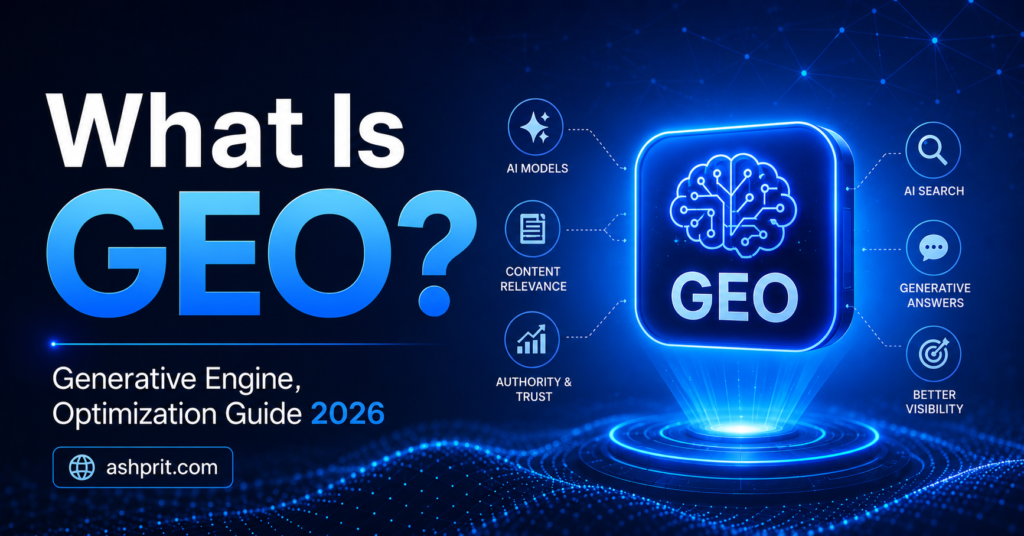
What is GEO? GEO (Generative Engine Optimization) is the process of optimizing content for AI-powered search engines and answer engines.
Introduction
Table of Contents
A few years ago, getting traffic from Google was relatively straightforward. If your website ranked on the first page for a keyword, people clicked your link, visited your site, and consumed your content.
Today, things are changing rapidly.
Millions of people are no longer relying only on traditional search engines. Instead, they are asking questions directly to ChatGPT, Gemini, Claude, Perplexity, and other AI-powered search systems.
Think about it.
When someone wants to know the best AI tools, how to start a blog, or how SEO works, they often ask an AI assistant instead of opening Google and browsing through multiple websites.
This shift has created a completely new challenge for website owners, marketers, bloggers, and businesses.
The goal is no longer just ranking on Google.
The new goal is getting your content discovered, trusted, and referenced by AI systems.
That is exactly where Generative Engine Optimization (GEO) comes in.
GEO is becoming one of the most important digital marketing concepts of this decade because it focuses on helping your content appear in AI-generated answers rather than relying only on traditional search rankings.
If you want your content to remain visible in the age of AI search, understanding GEO is no longer optional—it is essential.
In this guide, you will learn what GEO is, how it works, why it matters, how it differs from traditional SEO, and how you can optimize your website for AI-powered search engines in 2026 and beyond.
Quick Answer
Generative Engine Optimization (GEO) is the process of optimizing content so that AI-powered search systems such as ChatGPT, Gemini, Claude, Perplexity, and Google AI Overviews can easily understand, trust, and reference your content in their generated answers.
Unlike traditional SEO, which focuses on ranking web pages in search results, GEO focuses on increasing the likelihood that AI systems will cite, summarize, recommend, or use your content when answering user questions.
What Is GEO (Generative Engine Optimization)?
Generative Engine Optimization, commonly known as GEO, is a modern content optimization strategy designed specifically for AI-driven search experiences.
To understand GEO, let’s look at a simple example.
Imagine someone asks:
“What are the best AI tools for content creation?”
In traditional search, Google would display a list of websites.
The user would click one of those websites and read the content.
In an AI-powered environment, the process is different.
ChatGPT, Gemini, Claude, or Perplexity may generate a direct answer immediately.
Instead of showing ten blue links, the AI provides a summarized response based on information it considers useful, trustworthy, and relevant.
The critical question becomes:
“Will the AI use your content when generating that answer?”
GEO helps increase the chances that the answer is yes.
The purpose of GEO is to make content easier for AI systems to:
- Understand
- Trust
- Extract information from
- Summarize accurately
- Reference in generated responses
In simple terms, GEO helps your content become AI-friendly.
Why GEO Matters in 2026
For official SEO guidance, visit Google Search Central.
Google AI Overviews are changing how users discover information online.
Many people still believe that SEO alone is enough.
That assumption is becoming increasingly risky.
Search behavior is changing faster than most businesses realize.
Users are moving toward:
- ChatGPT
- Gemini
- Claude
- Perplexity
- Google AI Overviews
- AI-powered voice assistants
These systems are changing how people discover information online.
Instead of visiting multiple websites, users are receiving direct answers.
As this trend grows, websites that optimize only for traditional search may lose visibility.
Websites that optimize for both SEO and GEO will have a significant advantage.
The future belongs to websites that can perform well in both environments.
Think of it this way:
SEO helps people find your website.
GEO helps AI find your content.
In the future, successful websites will need both.
GEO vs SEO: What’s the Difference?
Many beginners assume GEO is simply another name for SEO.
It isn’t.
While both strategies aim to improve visibility, their goals are different.
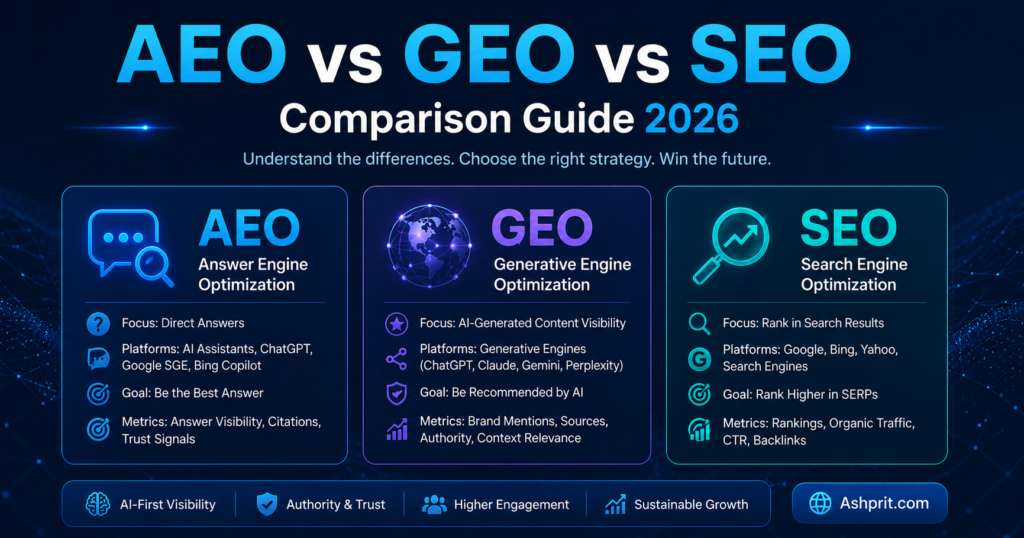
| SEO | GEO |
|---|---|
| Focuses on search rankings | Focuses on AI-generated answers |
| Optimizes for Google search results | Optimizes for AI systems |
| Measures rankings and clicks | Measures citations and references |
| Relies heavily on keywords | Relies heavily on context and authority |
| Targets search engines | Targets AI engines |
The best strategy today is not choosing between SEO and GEO.
The best strategy is combining both.
SEO drives traditional search traffic.
GEO improves visibility within AI-generated responses.
Together, they create a future-proof content strategy.
How AI Search Engines Find Information
To optimize content for GEO, you first need to understand how modern AI search systems work.
Many people assume that ChatGPT, Gemini, Claude, and Perplexity operate exactly like Google.
They don’t.
While traditional search engines mainly rank web pages, AI systems focus on understanding information, extracting context, and generating useful answers.
This changes how content should be written.
Let’s look at the major AI platforms.
How ChatGPT Finds Information
ChatGPT is designed to understand user intent and generate natural language responses.
When users ask questions, ChatGPT tries to identify:
- The main topic
- The user’s intent
- The context behind the question
- The most useful answer format
This means content written only for keywords is often not enough.
Instead, content should answer questions clearly and directly.
For example:
Poor GEO Content:
“AI tools are becoming increasingly popular among users worldwide.”
Better GEO Content:
“The best AI tools for beginners are ChatGPT, Gemini, and Claude because they are easy to use and support multiple tasks such as writing, research, and learning.”
The second example provides a direct answer that AI systems can easily extract and use.
How Google Gemini Finds Information
Gemini combines Google’s search ecosystem with AI-powered reasoning.
Gemini evaluates:
- Relevance
- Authority
- Accuracy
- Context
- Freshness
This means websites that consistently publish high-quality content have a better chance of being referenced.
Google increasingly prefers content that demonstrates:
- Expertise
- Experience
- Authority
- Trustworthiness
This is why E-E-A-T is becoming even more important in the AI era.
How Perplexity Finds Information
Perplexity operates differently from many AI assistants because it frequently cites sources.
When generating answers, Perplexity looks for:
- Reliable websites
- Structured information
- Clear explanations
- Credible references
Websites that organize information logically often perform better in Perplexity-generated responses.
This is one reason why long-form guides, tutorials, and educational content perform well.
How Claude Understands Content
Claude focuses heavily on context and reasoning.
It prefers content that:
- Explains concepts clearly
- Uses logical structure
- Provides detailed examples
- Avoids unnecessary jargon
If your content teaches rather than simply promotes, it becomes easier for systems like Claude to reference and summarize.
The Biggest GEO Ranking Factors
Many website owners ask:
“What actually increases the chances of being referenced by AI systems?”
Based on current AI search behavior, several factors consistently matter.
1. Topical Authority
AI systems prefer websites that demonstrate deep expertise on a subject.
Publishing one article about AI is not enough.
Publishing:
- AI Basics
- AI Tools
- AI Agents
- Prompt Engineering
- LLM Optimization
- AI SEO
- GEO
- AEO
creates topical authority.
When AI systems see multiple connected articles on the same subject, trust increases.
2. Clear Definitions
AI systems love definitions.
Why?
Because definitions are easy to extract and reuse.
For example:
What is GEO?
Generative Engine Optimization (GEO) is the practice of optimizing content so AI-powered search systems can easily understand, trust, and reference it when generating answers.
Notice how concise and direct the definition is.
This format increases the likelihood of AI citation.
3. Answer-First Content
One of the biggest GEO mistakes is hiding answers deep inside content.
Modern AI systems prefer answer-first writing.
Example:
Question:
What is GEO?
Answer:
GEO is the process of optimizing content for AI-generated search results.
Explanation:
GEO helps websites become more visible within ChatGPT, Gemini, Claude, Perplexity, and Google AI Overviews.
This structure works well for both users and AI systems.
4. Structured Content
AI systems process structured information more efficiently.
Good structure includes:
- Clear headings
- Subheadings
- Bullet points
- Tables
- Definitions
- FAQs
- Step-by-step instructions
Structured content reduces ambiguity and improves understanding.
5. Trust Signals
Trust is becoming one of the most important ranking factors.
AI systems increasingly look for signs that content is reliable.
Examples include:
- Author information
- About page
- Contact page
- Privacy policy
- Terms and conditions
- Consistent publishing history
These elements help establish credibility.
Why E-E-A-T Matters for GEO
Google introduced the concept of E-E-A-T:
- Experience
- Expertise
- Authoritativeness
- Trustworthiness
Although originally associated with SEO, these principles are becoming equally important for GEO.
AI systems prefer content created by sources they perceive as trustworthy.
For example:
A website that publishes hundreds of high-quality AI tutorials is more likely to be referenced than a website that publishes one shallow article.
Authority compounds over time.
The more valuable content you publish, the stronger your GEO signals become.
The Future of Search
The future of search is not SEO versus GEO.
It is SEO plus GEO.
Traditional search engines will continue to exist.
However, AI-generated answers are becoming increasingly common.
The websites that adapt early will have a significant advantage over those that rely solely on traditional SEO strategies.
In the coming years, businesses that optimize for both search engines and AI systems will capture the largest share of online visibility.
A Practical GEO Framework You Can Apply Today
Understanding GEO is important, but implementation is what creates results.
If you want your content to be discovered by AI systems, follow this practical framework.
Step 1: Identify User Intent
Before creating content, ask yourself:
What is the user actually trying to achieve?
For example:
Search Query:
“What is GEO?”
User Intent:
Learn the meaning of GEO.
Search Query:
“How to optimize content for ChatGPT?”
User Intent:
Find practical implementation steps.
The better you understand intent, the easier it becomes to create content that AI systems can understand and recommend.
Step 2: Provide Direct Answers
Many websites still hide answers behind long introductions.
AI systems prefer direct answers.
Bad Example:
“GEO has become increasingly important in the modern digital landscape.”
Better Example:
“GEO (Generative Engine Optimization) is the process of optimizing content for AI-powered search systems such as ChatGPT, Gemini, Claude, and Perplexity.”
Always answer the question first.
Explain afterward.
Step 3: Build Topic Clusters
One article is rarely enough.
Instead of publishing isolated content, create related content around a topic.
Example GEO Cluster:
- What Is GEO?
- GEO vs SEO
- GEO Best Practices
- GEO Tools
- GEO Content Strategy
- GEO Case Studies
- GEO for Bloggers
- GEO for Businesses
This creates topical authority.
AI systems are more likely to trust websites that demonstrate depth.
Step 4: Create AI-Friendly Formatting
Structure matters.
Use:
- Short paragraphs
- Clear headings
- Numbered steps
- Bullet points
- Tables
- FAQs
Avoid:
- Large walls of text
- Unclear structure
- Excessive jargon
Remember:
If humans find content easy to read, AI systems generally find it easier to process as well.
Step 5: Build Trust
Trust signals matter more than ever.
Every website should have:
- About Page
- Contact Page
- Privacy Policy
- Terms and Conditions
- Author Information
These pages help establish legitimacy.
For Ashprit, this foundation is already being built.
GEO Content Checklist
Before publishing any article, review this checklist.
Content Quality
✓ Answers the main question clearly
✓ Provides practical examples
✓ Uses simple language
✓ Covers the topic in depth
✓ Includes original insights
Structure
✓ Proper headings
✓ Short paragraphs
✓ Bullet points
✓ Table where appropriate
✓ FAQ section
Trust
✓ Author visible
✓ About page available
✓ Contact page available
✓ Privacy policy available
GEO Optimization
✓ Clear definitions
✓ Answer-first writing
✓ Topic cluster support
✓ Internal linking
✓ Updated information
Common GEO Mistakes
Many websites struggle because they make avoidable mistakes.
Mistake #1: Writing Only for Keywords
Old SEO often focused heavily on keywords.
Modern AI systems focus more on meaning and context.
Write for humans first.
Optimize second.
Mistake #2: Ignoring Topical Authority
Publishing one article about AI will not make your website an authority.
Publishing fifty high-quality AI articles creates authority.
Consistency wins.
Mistake #3: Creating Thin Content
A 500-word article rarely demonstrates expertise.
AI systems generally prefer comprehensive resources.
Whenever possible, create complete guides rather than superficial summaries.
Mistake #4: No Internal Linking
Articles should connect to each other.
Example:
This GEO article should eventually link to:
- What Is AEO?
- AI SEO Guide
- LLM Optimization Guide
- Best AI Tools
- ChatGPT vs Gemini
This helps users and AI systems understand your website’s expertise.
Best GEO Tools in 2026
While GEO is primarily a strategy, several tools can help.
ChatGPT
Useful for research, outlining, and content ideation.
Perplexity
Excellent for finding cited information and research sources.
Google Search Console
Helps monitor organic visibility.
Rank Math
Useful for on-page SEO optimization.
Ahrefs
Helpful for keyword research and content opportunities.
Semrush
Useful for competitive analysis and content planning.
Remember:
Tools support GEO.
They do not replace strategy.
Frequently Asked Questions
Is GEO replacing SEO?
No.
GEO complements SEO.
The future is SEO plus GEO, not SEO versus GEO.
Does GEO work for small websites?
Yes.
Even small websites can benefit from GEO if they publish helpful, trustworthy content.
Can ChatGPT directly rank websites?
No.
ChatGPT does not rank websites the way Google does.
However, it can reference, summarize, or recommend content.
Is GEO important for bloggers?
Absolutely.
Bloggers who adapt to AI search early may gain a significant competitive advantage.
Is GEO only for AI websites?
No.
Any industry can benefit from GEO, including:
- Education
- Finance
- Healthcare
- Technology
- Marketing
- E-commerce
What is the difference between GEO and AEO?
AEO focuses on optimizing content for answer engines.
GEO focuses on optimizing content for AI-generated search experiences.
While related, they are not identical.
What is the difference between GEO and LLM Optimization?
LLM Optimization focuses on making content understandable for large language models.
GEO focuses on increasing visibility within AI-generated search results.
Final Thoughts
Search is evolving faster than ever before.
For years, businesses focused almost entirely on traditional SEO.
Today, users are increasingly turning to AI-powered systems such as ChatGPT, Gemini, Claude, Perplexity, and Google AI Overviews to find information.
This shift creates both challenges and opportunities.
The websites that continue relying only on traditional SEO may struggle to maintain visibility in the long term.
The websites that embrace GEO early will be better positioned for the future of search.
The goal is no longer simply ranking on Google.
The goal is becoming a trusted source of information that both humans and AI systems can understand, trust, and reference.
If you are building a website in 2026 and beyond, GEO should be a core part of your content strategy.
The future belongs to websites that optimize for both search engines and AI engines.
Start now, stay consistent, and build authority one high-quality article at a time.
Also Read: What Is AEO (Answer Engine Optimization)?
Also Read: AEO vs GEO vs SEO

Pingback: Learn what AEO (Answer Engine Optimization) is, how answer engines work, AEO vs SEO, ranking factors, schema markup, AI search optimization, and practical strategies for 2026.
Pingback: AEO vs GEO vs SEO: Complete 2026 Guide to AI Search Rankings